
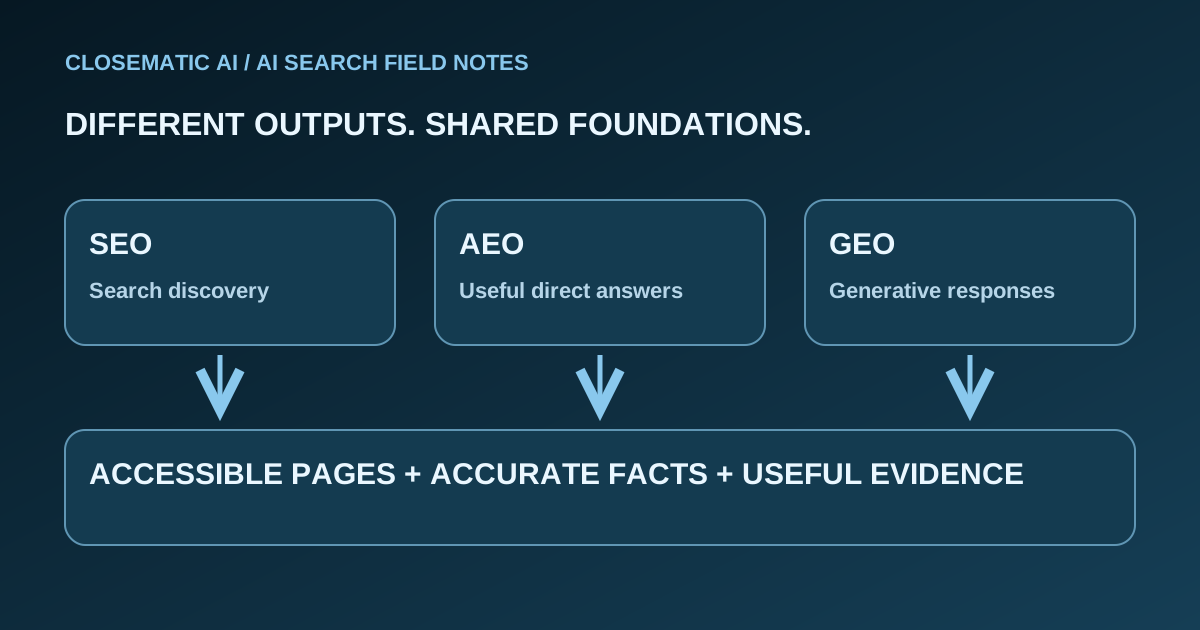
Use the labels to define work, not to multiply it
A local business does not need three conflicting descriptions of what it does. It needs accurate public information and useful explanations that customers can find and evaluate. SEO, AEO and GEO help frame different questions about that same information. Keep the underlying business facts consistent.
Terminology varies between providers. The definitions here are an explicit working framework for comparing tasks, not a claim that Google, OpenAI or Anthropic certify these three categories. Ask a provider what they will do and how you can verify it before comparing labels on proposals.
Google’s guidance for AI search features says existing SEO practices remain relevant. That supports treating search fundamentals as continuing work, not discarding them when an interface generates an answer.
Compare the work and the evidence
This table maps each label to a practical question. The examples are planning aids, not evidence of a particular company’s results. Read across a row to connect the label with a task and its completion evidence. Then identify any overlap before paying for the same deliverable under multiple names.
| Working label | Question for your business | Example task | Evidence to inspect |
|---|---|---|---|
| SEO | Can a relevant searcher find and understand our page? | Correct a service page and connect it to related pages | Working URL, accurate content and search observations |
| AEO | Does our information answer a specific customer question? | Explain what a service includes and what it excludes | A clear answer with appropriate supporting evidence |
| GEO | How is our business or information used in generated answers? | Prepare verifiable facts and review relevant AI answers | Saved answer, exact business identity and source links |
There is overlap in every row. A clear service explanation can support ordinary search discovery and answer a detailed question. Its usefulness does not depend on which label appeared on the work order.
For the local discovery layer, Google Search versus Maps explains why a profile result and a website result require separate checks. For the answer layer, start with how Google AI Overview links work.
Follow one customer decision across the three views
Consider a fictional plumbing business evaluating content about a slow kitchen drain. This is an illustration, not a customer story or service recommendation. Follow the same customer decision through each view, noticing how the task changes while the underlying service facts must remain the same.
The owner might first discover that the business has no useful page explaining the service. In an SEO work list, the task is to create a discoverable page with accurate service and coverage information. The owner must confirm what the company actually offers before a writer supplies the description.
From an AEO view, the page should answer practical questions: what information should the customer provide, what is included in an assessment and what cannot be priced without inspection? The useful content is the answer to the decision, not a repeated slogan about the company’s quality.
From a GEO view, the owner would inspect relevant generated answers and check whether any business mention is accurate, whether a source is linked and whether the answer proposes the business for a suitable need. An answer that cites an educational explanation may not recommend the service at all.
The result is one coordinated project with different checks. It is not automatically three pages, three subscriptions or three separate sets of business facts. The practical GEO guide provides a fact register to keep those checks connected.
Fix shared foundations before adding another content layer
Start with a short inspection of the pages customers are expected to use. Is the company identity clear? Are services and coverage accurate? Can the reader find the next step? Are contact details consistent? Can the public page be accessed without an account?
Google’s people-first content guidance encourages original value, clear sourcing and information made to help readers. For a service business, apply that as a practical editorial check: does the page resolve a real question using facts you can defend?
For the division of responsibilities between the business and its tools, read what local SEO software can and cannot do. A software feature should be evaluated against the specific task, even when the same task supports several search experiences.
Decide whether a new page earns its place
Before adding an article, write down the question it answers and the page readers should visit next. If another page already answers it well, improve that page instead of making a near-duplicate. If the question is distinct, choose the format that makes the decision easier.
A comparison table may suit two different service options. A troubleshooting sequence may suit a problem that needs diagnosis. A process explanation may suit customers who are unsure what happens after contacting the business. These are editorial choices, not special requirements imposed by an AI engine.
Use the AEO checklist for a page-level review before expanding the content library.
Keep the destination and the search mode visible in your report
“AI visibility” is too broad to be a complete measurement description. Record whether the observation came from Google AI Mode, Google AI Overview, ChatGPT or Claude, along with the question and location context. Do not combine unlike experiences without explaining the method.
OpenAI describes ChatGPT web search as a way to use current web information with sources. Anthropic describes Claude web search and direct retrieval from URLs. In a test, record whether you asked the system to discover a provider or supplied the provider’s URL yourself. Those tasks answer different questions about discovery.
For Google’s AI experiences, use the measurement guide to distinguish a saved answer from aggregated search performance. A broad report should not conceal which evidence belongs to which experience.
Separate the path to a sale into observable steps
Use this worksheet to keep progress claims precise. It is a reporting model you can adapt, not a promise that every customer follows the same path. Identify which records your business actually has at each stage, and leave any missing connection explicit instead of filling it with an assumption.
| Stage | Evidence you might have | Safe conclusion |
|---|---|---|
| Page is accessible | Public page and technical inspection | The inspected page can be read under those conditions |
| Business appears | Saved search result or answer | The business appeared in that observation |
| Visitor arrives | Available analytics record | A visit was recorded with the available source information |
| Person asks a question | Form submission or conversation | An inquiry was received |
| Work is purchased | Confirmed business record | A sale occurred under that record |
Do not infer the final row from the first two. If tracking cannot connect a sale to a search experience, report the sale and the attribution gap separately. This lets the business improve visibility and conversion without overstating either.
Choose the next task from a real gap
When time is limited, prioritize a known problem over a fashionable deliverable. A wrong phone number, inaccessible service page or unclear offer gives you a concrete task to correct. A new acronym alone does not. Write the evidence you expect to inspect when the task is finished.
| Current gap | Useful first task | Completion check |
|---|---|---|
| Conflicting business facts | Confirm one authoritative fact set | Relevant public pages agree |
| Service scope unclear | Rewrite the service explanation with the owner | Included work and limits are explicit |
| Public page inaccessible | Diagnose access with the webmaster | Intended content loads correctly |
| AI claim has no evidence | Save the exact answer and inspect its sources | Claim is supported, corrected or marked unverified |
| Tool proposal vague | Request a complete workflow demonstration | Task, owner and output are documented |
The software evaluation guide expands the last row into a buying worksheet. For implementation scope, compare Closematic’s local SEO, AEO and GEO pages, then inspect the platform. Treat a demonstrated feature as evidence of that workflow, not of a guaranteed search outcome.
Checklist: one business foundation, distinct checks
Before approving a plan, check whether its tasks and evidence remain understandable without the labels. Use this list to align the people handling content, business information and reporting. Assign each unresolved question to an owner, rather than letting the same uncertainty appear under three different workstreams.
- Agree on the definitions being used in the proposal or report.
- Verify company, service, coverage and contact facts once, then maintain consistency.
- Map each content page to a real customer decision.
- Keep Google Search, Maps and individual AI experiences identifiable.
- Separate direct URL retrieval from unprompted provider discovery.
- Report visibility, visits, inquiries and sales according to the evidence available.
- Choose the next task by its demonstrated gap and name its completion check.
A good plan should be understandable even after you remove the acronyms. You should still know what will change, who owns the work and what evidence will show that it was completed.
