
Choose one public page and one customer question
An effective AEO check starts with a defined question and a page that should answer it. For a local service business, that could concern service coverage, preparation, scheduling or what a job includes. Use questions supported by real conversations or research; do not present an invented example as customer demand.
Google’s existing SEO fundamentals apply to its AI search features. There is no separate technical optimization requirement for them. Google’s AI features guidance
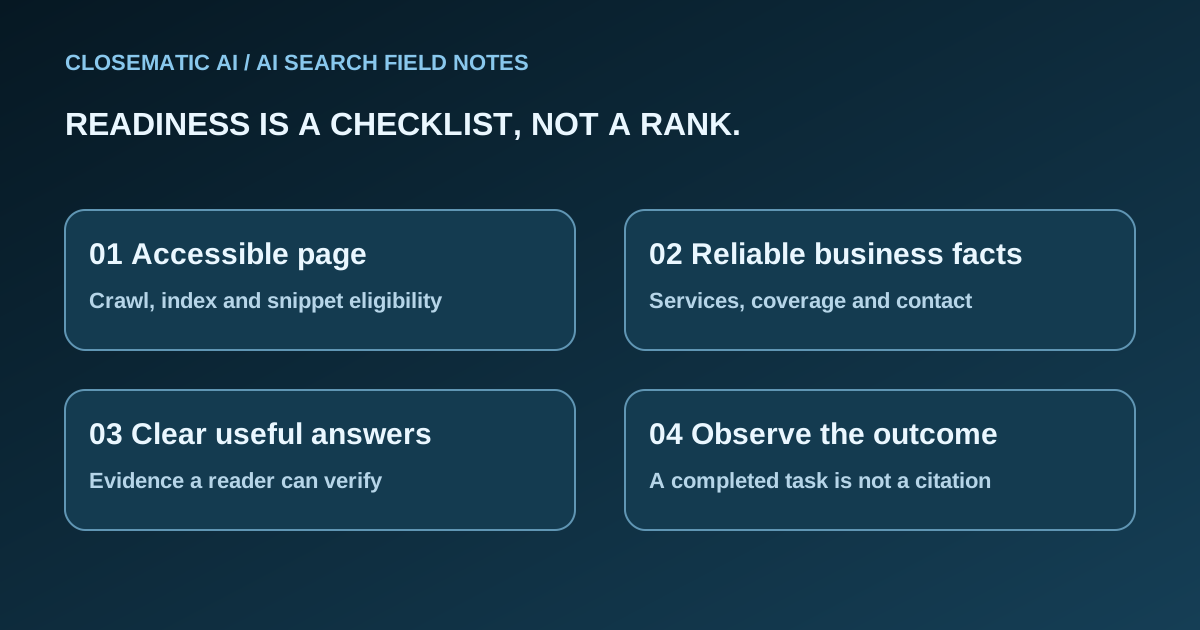
The checklist below is our practical review method. Its evidence labels and priority order are not Google ranking factors. They help an owner distinguish a verified correction from a task that was merely attempted.
Write your scope at the top: public URL, customer question, intended answer, owner and next step. If the question is “Do you serve my area?”, a generic homepage slogan is not a sufficient answer. Identify the page or section that should provide the actual service-area information.
Check access without exposing private pages
Inspect only pages approved for public discovery. Google requires an accessible page with a successful response and indexable content. A working page on your phone does not establish what Google’s crawler received. Keep those two observations separate in the record. Google’s technical requirements
In Search Console, inspect the exact URL. Compare the indexed result with a live test when investigating a recent correction. The live test cannot tell you which canonical URL Google will ultimately select. URL Inspection guide
Have a technical owner check these items when necessary:
- The intended public page opens at the expected URL.
- Crawler access is not unintentionally blocked by hosting or site configuration.
- The page does not carry an unintended indexing exclusion.
- Important information appears as readable page text.
- Internal navigation links to the page from a relevant public page.
Preview controls deserve deliberate review. noindex controls exclusion from the index; nosnippet, max-snippet and data-nosnippet control previews or use of portions of content. Google must be able to crawl a page to read its page-level directives. Google’s robots and preview specifications
Do not delete exclusions across the whole domain to resolve one service-page issue. A customer login and a public service guide have different purposes. Preserve that boundary throughout the review.
Use an evidence column for every checklist item
Mark each row verified, needs correction, not checked or not applicable, with reason. Do not use a single “SEO done” box. The evidence column should let another person reproduce the check without guessing what you looked at or which result you considered acceptable.
| Check | Evidence to keep | A useful completion condition |
|---|---|---|
| Public destination | Exact final URL and visible page | Intended content opens without a login |
| Search access | Relevant inspection result and technical finding | Identified access issue corrected and retested |
| Service facts | Business owner’s verified service description | Public page describes actual work and exclusions |
| Service area | Current coverage information | Page does not imply nonexistent offices |
| Customer answer | Question and answering passage | Answer is clear without relying on an image alone |
| Trust evidence | Original source for qualifications or examples | Claims can be substantiated by the business |
| Structured data | Markup and matching visible information | Entities and facts agree with the page |
| Next step | Completed navigation or form check | Reader can reach the relevant action |
| Search observation | Saved response and source URL, if observed | Appearance recorded separately from preparation |
For every failed row, add an owner and a specific action. “Improve authority” is too vague to verify. “Replace the outdated service area on the drain-cleaning page using the owner’s current coverage list” is a task with a clear finish.
If the missing object is your Business Profile rather than a webpage, use the profile visibility diagnostic. Do not treat those two investigations as interchangeable.
Write the answer from facts your team can defend
A useful service answer explains what happens during the work, who it is for, relevant limitations and the next step. It should help a customer decide whether to continue, even when the answer is that the service does not fit their request.
Google’s content guidance encourages original value, clear sourcing and information that helps the intended audience. Use that as a quality review, not an invitation to manufacture credentials or experience. People-first content guidance
Consider a hypothetical appliance-repair page. The business should verify the appliance types it handles, the area it serves and what information a customer needs when requesting help. If same-day visits are not a confirmed commitment, do not insert that claim because it sounds persuasive.
A compact answer can use this pattern:
- Direct response: State whether the business provides the relevant service.
- Scope: Explain what is included and what needs a separate assessment.
- Preparation: Tell the customer what to provide or check.
- Evidence: Link to a real qualification, process explanation or relevant policy when available.
- Next step: Offer the appropriate service or contact route.
These are writing prompts, not mandatory schema fields. Use only the parts that answer the actual question. If a guide already covers a related question well, link to it instead of reproducing the whole guide in a new page.
Match structured data to what customers can see
Review structured data after the public facts are correct. Google requires markup to represent the page accurately and prohibits misleading or irrelevant structured content. Its guidelines also warn that valid markup does not guarantee a rich result. Structured data guidelines
For this checklist, compare the organization name, page URL, service description and any authored content against the visible page. Do not add an award, rating, qualification or office address merely to fill a field. Mark a field inapplicable when the underlying fact does not exist.
A validator can detect some structural problems. It cannot confirm that your team genuinely provides a service or holds a qualification. Have the factual owner review the claims as well as the technical result.
Diagnose absence with the right question
When a business does not appear, first identify what is missing. The feature itself, a company name, a supporting link and a normal webpage result are different observations. Choose the next investigation from that distinction rather than changing every part of the site.
| Observation | Next useful check |
|---|---|
| No AI answer appeared | Record the surface and conditions; retain as an observation |
| AI answer appeared without the company | Review relevant public facts and pages; do not infer a technical penalty |
| Company mentioned, destination unclear | Open source links and identify the exact URL |
| Desired public webpage absent from the index | Investigate that URL’s indexing status |
| Business Profile unavailable | Follow the profile-specific diagnostic |
| Incorrect fact in an answer | Trace the source if available, then correct information you control |
Read how AI Overview links work before treating any one row as proof of a recommendation. For other engines, use the GEO guide rather than assuming Google’s controls describe every provider.
Close the work with a checked result
The final record should say what changed and what remains unknown. A corrected service description is a completed content task. A fresh search appearance is a separate result. Keep both records, then use the visibility measurement protocol to compare observations consistently.
- Confirm the public page and customer question.
- Fix access failures and inaccurate facts first.
- Check the answer and its supporting evidence.
- Match markup to visible content.
- Test the reader’s next step on a phone.
- Assign unresolved issues to an owner.
- Record search appearances without converting them into guarantees.
If you want software to support this work, review Closematic AI’s AEO approach and ask which tasks fit your workflow. The business still owns the accuracy of its information; a completed checklist does not transfer that responsibility to a tool.
