
Start with a customer decision, not an AI acronym
A local customer needs to know whether you perform the work, serve their area and fit their situation. GEO gives you a reason to inspect how those facts appear in generated answers. It does not remove the need to explain them clearly on your own website.
Use this guide as an operating method: document facts, connect them to public evidence, check access and review actual answers. The worksheets below are our suggested process, not a ranking formula or a measured customer case study. For the boundaries between disciplines, read SEO, AEO and GEO compared.
Imagine a homeowner comparing an HVAC repair visit with a maintenance agreement. Those are different decisions. A useful service page explains the difference, who each option is for and what the customer must confirm before booking. A page that repeatedly says “best HVAC company” leaves those questions unanswered.
Build a business fact and evidence register
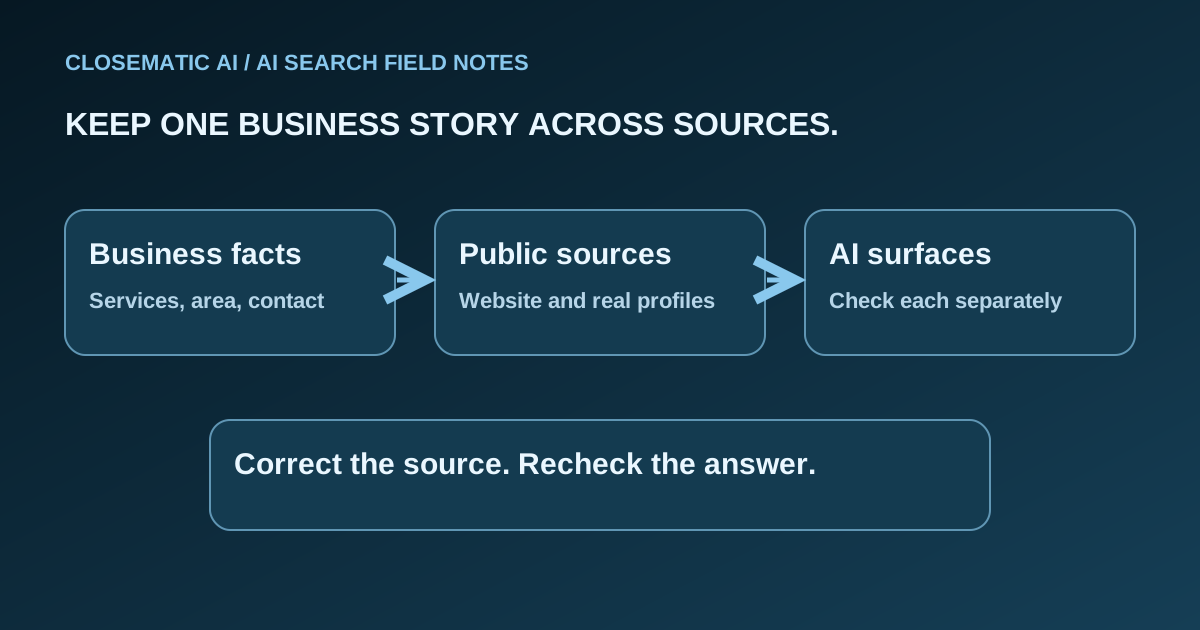
Before writing more pages, make one working list of information customers should be able to trust. Assign an owner to each fact and identify the public page where it can be checked. This prevents different pages from making incompatible promises.
| Fact | Public evidence to prepare | Question for the owner |
|---|---|---|
| Business identity | About and contact pages with consistent naming | Is this the name customers should recognize? |
| Service scope | A page explaining included and excluded work | Can the team deliver everything stated here? |
| Service area | Accurate coverage and relevant restrictions | Are these places genuinely served? |
| Booking process | Clear next step and required information | What happens after someone contacts us? |
| Qualifications | Verifiable credentials, where applicable | Is the claim current and approved for use? |
| Service evidence | Authorized project details or genuine reviews | Can we publish this without inventing or exposing private data? |
A missing fact becomes a question for the business, not permission to fill the gap with plausible copy. If you cannot substantiate a certification or response-time promise, leave it out until the owner confirms it.
Connect explanatory articles to the service page that can help the reader act. The local SEO software guide explains how business responsibilities differ from work organized through software.
Check the public page before changing crawler settings
Begin with the exact page customers should discover. Open it without logging in. Confirm that the service explanation is visible as text, the business can be contacted and the intended URL works. Ask your webmaster to inspect redirects, indexing controls and access restrictions when something does not match.
Google’s technical requirements include crawler access, a successful HTTP response and indexable content. Meeting them establishes eligibility, not assured indexing. Use that distinction when a report says “technical checks passed.”
Keep private systems and public marketing pages separate. A customer dashboard, internal tool or confidential record does not need to become public for your service page to explain your offer. Do not remove authentication or expose private information to solve a search visibility question.
For a page that is available but not appearing, use the AEO checklist to separate factual gaps, access checks and answer observations.
Treat each AI search experience as a separate observation
Google AI Mode, Google AI Overview, ChatGPT and Claude are not one shared listing you can activate. Record the exact experience used and inspect its answer instead of copying a conclusion from one product to another. Keep the question and the supporting source with each observation.
For Google, existing SEO practices remain relevant to AI features. Supporting pages must be indexed and eligible for a snippet. Inclusion remains Google’s decision. This is why the public page and its content come before claims about a special GEO setting.
For ChatGPT, OpenAI distinguishes OAI-SearchBot for search from GPTBot for potential training use. ChatGPT-User serves certain user-initiated actions. These are different purposes. ChatGPT search can provide source links; open the cited page to see whether it supports the business claim.
For Claude, Anthropic documents Claude-SearchBot, Claude-User and ClaudeBot separately. They address search, user-requested access and potential training use. Its web search documentation describes cited web answers and direct retrieval from supplied links. Asking Claude to read your URL is not the same test as asking it to find a suitable local business.
Separate a mention, citation and recommendation
Use a simple observation sheet. Save the question, service area, platform, whether search was used, answer and source URLs. Then classify what you saw. A positive result in one row should not silently fill the others. Check the actual wording before assigning a label.
| Observation | What you can report | What it does not establish |
|---|---|---|
| Business name appears | A name mention in the saved answer | That the correct company or service was identified |
| Your page is linked | A citation or link to that URL | That the answer recommends purchasing from you |
| Your service is proposed | A recommendation in that recorded context | Placement for other questions, people or locations |
| A visitor arrives | A visit in the available analytics evidence | A qualified inquiry or completed job |
An answer can cite your educational guide while recommending no provider. Another can mention a company with a similar name. Read the surrounding words and check the destination before putting either into a visibility report.
Turn missing or incorrect appearances into specific work
Avoid responding to every missing mention by writing another article. First identify the type of problem and the smallest useful action. Use the decision list below to turn an observation into a task, with an owner and a completion check. Separate a verified problem from a result you simply have not observed.
- Wrong business facts: correct the authoritative pages you control and record which external source carried the error.
- Unclear service fit: explain the actual service, boundaries and customer decision on the relevant page.
- Access problem: have the webmaster test the public URL and applicable search controls.
- No observed appearance: record that result; review question relevance and source coverage without asserting a hidden penalty.
- Correct citation but few inquiries: inspect the cited page’s relevance and next step before calling discovery a sales result.
Keep one change log so you can tell what changed between observations. The AI visibility software evaluation guide shows how to ask a vendor for evidence of this work without buying an unexplained score.
Choose an operating workflow you can maintain
Closematic AI’s GEO solution page explains the offer’s focus. On The New Google & AIs, our system and team make your business information available to ChatGPT, Claude, Gemini, Perplexity, Meta AI and other apps people ask, and build your local website. Lily assists the business owner; she does not reply to your customers.
Use the platform demonstration to inspect relevant tasks. A feature category is not proof of every integration or of dedicated ChatGPT and Claude monitoring. Ask about the exact workflow your business needs before relying on it.
Your next-action checklist
- Write down the customer decision and service area you want a page to answer.
- Verify business facts and assign an owner for updates.
- Check the intended public page without exposing private systems.
- Save separate observations for each search experience.
- Distinguish mentions, citations, recommendations and business outcomes.
- Fix a demonstrated gap, then repeat the same check and retain both results.
The useful result is a clearer, verifiable business presence and an honest record of what was observed. A recommendation remains an external system’s choice.
