
Decide whether you need observation, execution or both
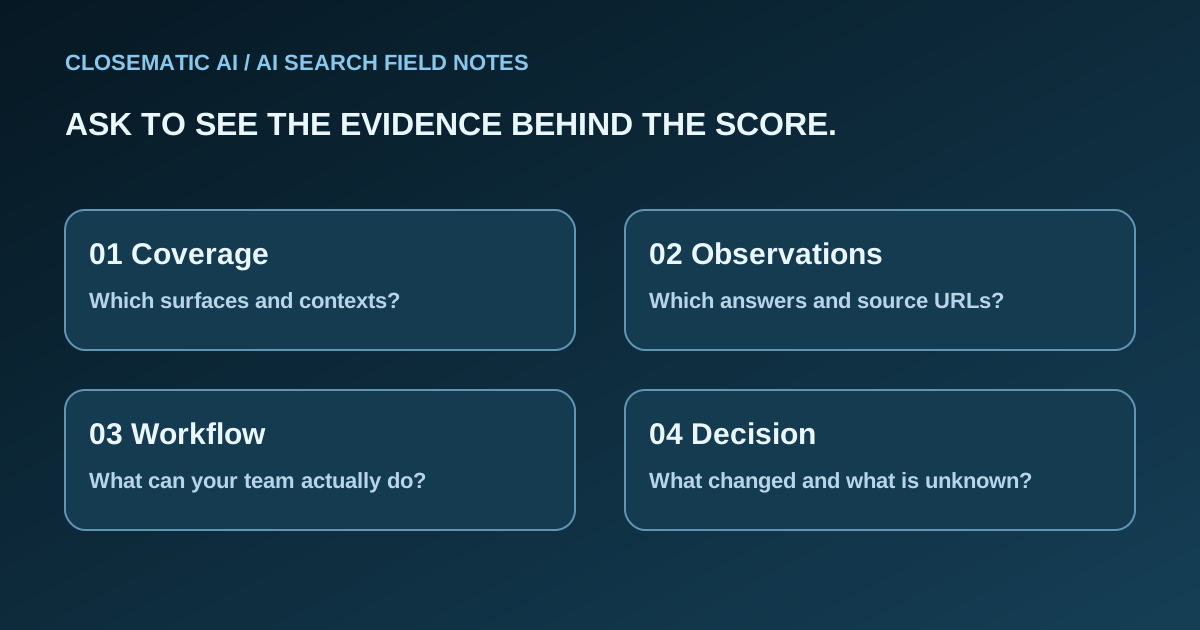
Before comparing products, finish this sentence: “After opening the tool, I need to be able to…” The answer might be inspect an AI answer, correct business information or follow up with an inquiry. Those are different workflows, even if each appears under an “AI visibility” heading.
A monitoring tool may help you see a gap without doing the work to close it. An operational tool may help you manage a business task without monitoring every AI experience. Ask for both demonstrations if your purchase depends on both capabilities.
The worksheets below are a proposed evaluation method, not an independently tested ranking of vendors. For the broader terminology, read SEO, AEO and GEO. For questions about service management and setup, use the local SEO software buying guide.
Make the vendor define its coverage
“Tracks AI” does not identify a platform, interface or question. Ask for a written coverage table and fill it before comparing percentages. A missing answer should remain “unverified,” not become an assumed feature. Match the table to the actual experiences your customers use.
| Coverage question | Evidence to request | Why it affects your decision |
|---|---|---|
| Which experience is observed? | Named product and interface | Google AI Mode is not the same observation as ChatGPT |
| How are questions chosen? | The actual prompt list and selection method | Branded questions test different needs from category searches |
| What location is used? | Explicit location settings or stated limits | A service area’s context must be interpretable |
| Was web search used? | Search mode and available source evidence | A generated answer alone does not explain retrieval |
| When was it observed? | Timestamp and run history | An old example is not a current observation |
| What happens on failure? | Error, unavailable and no-mention states | A failed collection should not silently count as absence |
OpenAI’s search help and Claude’s web search documentation describe web-enabled experiences. Use those official descriptions to formulate questions about search mode; they do not validate a third-party vendor’s coverage.
For Google reporting boundaries, AI feature traffic is included in the Web search type in Search Console. If a vendor claims a dedicated AI-only report, ask how it obtained and separated that data. Do not infer a dedicated breakdown from a general Search Console connection.
Inspect one result from question to source
Choose one important customer question and ask the vendor to open the underlying observation. Follow the chain: question, platform, conditions, response, source links and classification. You should be able to understand the reported outcome without relying solely on the tool’s score.
Check whether the business identity is correct. A similar name, franchise branch or directory listing may require a different interpretation. Next, read the sentence around the mention. Does it simply name the company, use a page as a source or suggest the company as an option for the stated need?
Finally, open the source. A citation to a guide does not necessarily support a claim about a company’s service area or qualifications. Record unsupported or ambiguous claims instead of counting every link as an endorsement.
The GEO guide provides a simple distinction between mentions, citations and recommendations. Use consistent definitions across vendors so a broader counting rule does not appear to be a better business result.
Keep discovery tests separate from supplied-URL tests
A request that names your company or provides your URL can be useful for checking facts or page retrieval. It does not test the same thing as a customer asking for a service provider without knowing your brand.
Ask the vendor to label those query groups. You may want both, but combining them can hide whether your business was found independently or introduced by the question itself. Keep the prompt wording available so the classification can be checked later.
Ask how the score is calculated
A number without a denominator is difficult to use. Ask which runs count, how failed runs are handled and whether a citation is weighted differently from a name mention. Request an example calculation you can reproduce. Keep that method with the report so later comparisons use the same definitions.
Here is a deliberately fictional worksheet, not a Closematic result or industry benchmark: a report shows a business mentioned in 4 of 10 saved answers. That is 40% of that sample. It does not mean 40% of all people using AI saw the business. If the next sample contains different questions, comparing the two percentages without explaining the change can mislead the reader.
Ask these follow-up questions:
- Can I inspect the observations that form the numerator and denominator?
- Are unavailable answers excluded or counted as zero visibility?
- Are repeated runs of the same question identifiable?
- Does changing my prompt set change historical comparisons?
- Are branded and nonbranded questions reported separately?
- Can I distinguish a citation to my domain from a mention sourced elsewhere?
Use the AI Overview measurement guide when translating sampled observations into a report. Keep sample-based evidence separate from a claim about all users or total market share.
Follow a finding through to a useful action
Suppose a report identifies an outdated service description. Ask what happens next. Does the product identify the source, suggest a change, publish an approved correction or simply flag the issue? Each can be useful, but they are different deliverables with different responsibilities.
Name a person responsible for acting on findings. A report without an owner can become a recurring expense with no operational follow-through. Conversely, an automated action without a clear review step may change facts the business has not confirmed.
| Finding in the demonstration | Follow-up question | Completion evidence |
|---|---|---|
| Incorrect business description | Which source should we correct? | Approved source displays accurate facts |
| Missing service explanation | Who supplies and approves the information? | Useful page answers the identified question |
| Inaccessible public page | Who diagnoses the access failure? | Intended page is publicly readable |
| Apparent increase in mentions | Did the observation method stay the same? | Comparable saved samples and disclosed limits |
| More inquiries claimed | What records show those inquiries? | Contact records, separately from visibility results |
This worksheet tests the transition from insight to work. It does not claim that correcting a source will force an AI system to update or recommend the business on a particular schedule.
Compare the total operating commitment
Price is only part of the commitment. Ask who configures the system, reviews content, maintains business facts and follows up with customers. Verify any required integration before assuming your existing workflow will continue unchanged. Include that verification in your buying decision, alongside the subscription charge.
For a monitoring purchase, ask about question limits, update frequency, supported locations and retention of observations. For operational software, ask about access, approvals and the exact business tasks it supports. Request exit and export details if they are essential; this guide does not assume every vendor offers them.
The local SEO cost guide provides a separate worksheet for software, service fees and your own team’s time. Use it alongside the coverage worksheet instead of choosing solely on the largest feature count.
Where Closematic AI belongs in the evaluation
Closematic AI is an automated local SEO, AEO and GEO service with its own software platform: our system and team do the work for you. The New Google & AIs plan adds presence in ChatGPT, Claude, Gemini, Perplexity and Meta AI, a leads inbox, reports and Lily. Lily helps you, the business owner. Review the platform for the operational demonstration and the GEO solution for the stated focus.
This article is not a claim that Closematic includes every monitoring capability listed above. Dedicated ChatGPT or Claude monitoring, prompt sampling, share-of-voice calculations and third-party data exports should not be assumed from a general reporting feature. Ask about a specific requirement before treating it as part of your plan.
The New Google plan is US$97 per month and The New Google & AIs plan is US$247 per month, with automatic monthly renewal from purchase, no setup fee and no minimum term. You do a simple self-setup; our system and team do the ongoing work. Cancellation is available through email or support, access continues through the paid period and refunds are considered case by case under the subscription terms.
Before-you-buy checklist
Close the comparison with a short record of verified capabilities and unresolved requirements. Use the checklist below before paying, especially when a purchase depends on coverage of a particular AI experience. Ask for the missing demonstration instead of treating a general sales description as evidence.
- Define the operational task or observation your business actually needs.
- Confirm each required platform and interface with evidence.
- Inspect a full result, including its question and source links.
- Understand the score’s sample, denominator and failure handling.
- Separate direct URL tests, branded queries and independent discovery queries.
- Name the person who acts on findings and approves factual changes.
- Verify recurring terms, setup work and any essential integration or export.
- Leave missing capabilities marked unverified until the vendor demonstrates them.
A useful purchase leaves you knowing what you can do, what you can inspect and what remains outside the tool’s control. That is a stronger basis for choosing software than an unexplained visibility promise.
