
Follow the answer to the actual page
To understand an AI Overview appearance, inspect three things: what the answer says, which URL it links to, and what that page supports. A business name in a response is not enough to establish a recommendation, a website citation or a customer visit. Each needs its own evidence.
Google describes AI Overview and AI Mode as search experiences with supporting links. Their responses and sources can differ. They may search related subtopics while forming an answer, a technique Google calls query fan-out. That description does not disclose a formula for earning a link. Google’s AI features guide
For a service business, the practical question is: Does this appearance help a potential customer verify something useful about our work? That question is more actionable than counting every appearance of the company name as a win.
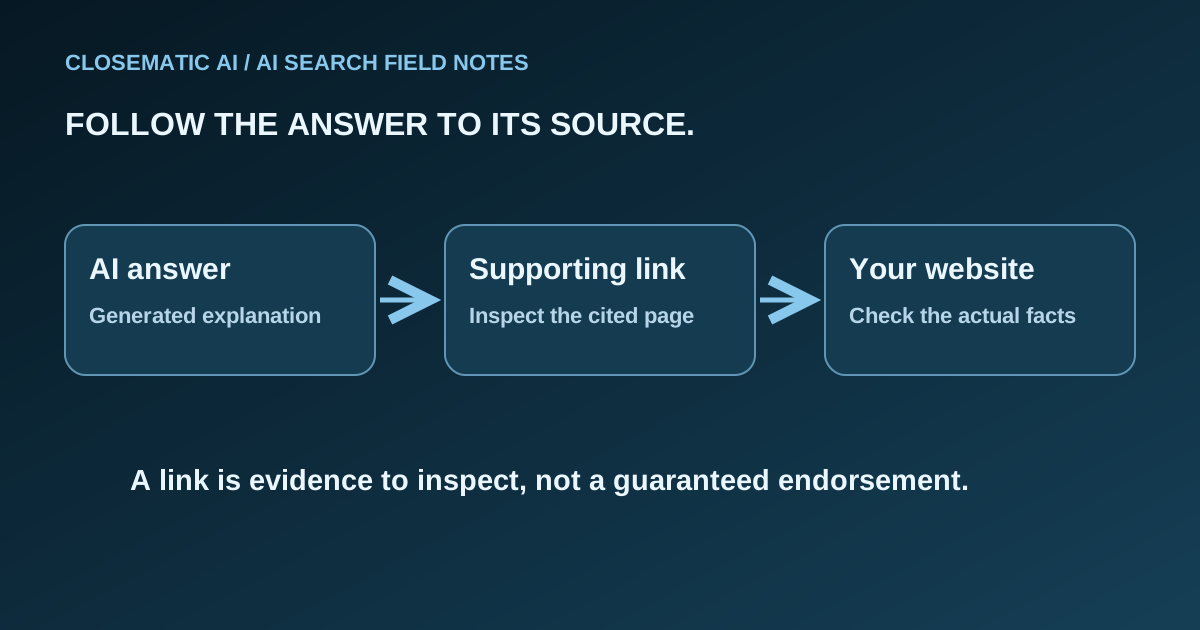
Read the three-stage diagram
Use the diagram above as an inspection route, not a diagram of Google’s internal systems. Start with the original question, follow the generated response to its linked page, then judge whether the page helps the reader make the next decision.
- Question: Save exactly what the searcher asked. “How do I prepare for a roof inspection?” differs from “Who can inspect my roof nearby?”
- Answer and link: Note the statement around the link. Open the source and copy its final destination URL.
- Destination: Find the passage that addresses the question. Check whether the reader can identify the business, the service and an appropriate next step.
The roof questions are illustrative, not measured customer queries. Their purpose is to separate informational discovery from provider selection. A preparation checklist can be useful without being a recommendation to hire its publisher.
If the source opens a directory or publisher article, record that third-party destination. Do not relabel it as a direct citation of your own site. The distinction matters later when you investigate which pages may have brought people to you.
Classify the appearance before reporting it
Give each observation a label your team can reproduce. These labels are an editorial reporting method, not official Google metrics. Several can apply to one response, but they should remain distinct in your notes. Save the evidence that supports each classification.
| What you observe | Defensible description | What remains unproven |
|---|---|---|
| Business name, no verified link | Brand mention in this response | A direct website citation or visitor |
| Link to a page on your domain | Supporting link to that specific page | Recommendation, click or inquiry |
| Link to a directory listing | Third-party source mentioning the business | A direct visit to your website |
| Explicit suggestion to consider your business | Recommendation observed in that response | Permanent placement or suitability for every customer |
| Someone contacts your company | Inquiry received | Its discovery source unless you have supporting evidence |
This classification prevents an attractive screenshot from doing more work than its evidence allows. If the destination cannot be opened or the company name is ambiguous, preserve that uncertainty. Do not choose the more flattering category to complete a report.
For a repeatable collection method, use the AI Overview visibility protocol. It separates completed checks from missing observations and keeps AI Mode in a separate group.
Understand eligibility without treating it as a promise
Google says a supporting webpage must be indexed and eligible for a search snippet. Meeting that requirement does not guarantee selection. No special AI schema or additional AI file is required. Check eligibility before evaluating the quality of an observed appearance. AI eligibility guidance
The underlying Search requirements include Googlebot access, a successful page response and indexable content. Google Search technical requirements
If a desired public guide is absent, inspect that exact URL in Search Console. The indexed report describes Google’s stored view; a live test checks the current page. A successful live test is not proof of indexing or selection for an AI answer. URL Inspection documentation
Keep private account pages and intentionally excluded offers separate from public educational pages. An indexing investigation is not a reason to expose a customer portal. The local business AEO checklist turns the public-page checks into a record your team can act on.
Make the destination useful after the click
Review the linked page on a phone with one task in mind: can someone quickly verify the answer and decide what to do next? A citation is only a discovery event. The page still has to earn the reader’s attention and explain the service accurately.
For a local service guide, check the following:
- The opening answers the specific question rather than repeating a slogan.
- The process described matches what your team actually does.
- Any service-area statement is accurate and does not imply an office that does not exist.
- Photos, qualifications and examples belong to the business and support their accompanying claims.
- The contact option works and explains what the person is requesting.
- Links to related service information help the reader continue without searching the whole site.
For example, a hypothetical inspection-preparation page could explain access requirements, what information to have ready and how to request a visit. Do not invent an inspection certification, arrival promise or emergency service to make that example sound stronger.
The distinction between SEO, AEO and GEO helps you decide whether the next task concerns ordinary search discovery, answer clarity or observations across several AI systems.
Turn the observation into one useful action
Finish with a short evidence card: question, surface, response description, final source URL, relevant passage and next action. Keep “what appeared” separate from “what we think caused it.” If the evidence shows only one observed supporting link, say exactly that.
Choose an action connected to a real gap. Correct an outdated fact, clarify a confusing explanation or repair a broken destination. Avoid rewriting a sound page repeatedly because one later search returned different sources.
When assessing a software workflow, use this same evidence card to ask what the tool can help you maintain and what you must verify yourself. Explore Closematic AI’s AEO approach to review its role in the broader system, then compare it with the tasks your business needs.
Before sharing the result
- Identify the exact search experience.
- Open and verify the linked URL.
- Distinguish mention, citation and recommendation.
- Check the destination’s factual accuracy.
- Preserve the observation context.
- State the next action without promising future placement.
